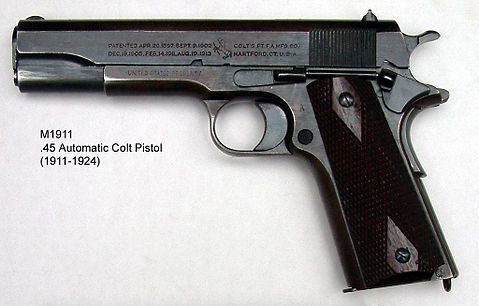
The Colt M1911 is one of the most iconic pistols in world military history. Designed by legendary gunsmith John Moses Browning, it was adopted by the U.S. Army in 1911 and served for over 70 years as an official service weapon. Its .45 ACP (Automatic Colt Pistol) caliber design has earned it a reputation for reliability and unmatched stopping power.
History and Origins of M1911
The history of the M1911 begins in the 1900s, when the U.S. Army was looking for a more powerful handgun than the .38 Long Colt revolver used in the war in the Philippines. American soldiers had found that this caliber lacked stopping power against determined opponents.
In 1906, the U.S. government launched a competition for a new semi-automatic service weapon in . 45 caliber. John Moses Browning, who was then working for Colt’s Manufacturing Company, presented a revolutionary design. After a series of rigorous tests conducted between 1907 and 1911, Browning’s pistol was officially adopted on March 29, 1911 as the “Pistol, Caliber .45, Automatic, M1911”.
In the famous tests of 1910-1911, Browning’s prototype fired 6,000 rounds in two days without a single failure — a remarkable performance that impressed the selection committee. In comparison, the competing Savage Arms pistol fired only 37 shots before experiencing its first problems.
Technical Specifications
The M1911 is a semi-automatic single-action (SA) pistol, operating on the principle of short recoil. Its design incorporates several innovations that have become industry standards.
| Feature | Specification |
|---|---|
| Caliber | .45 ACP (11.43 × 23 mm) |
| Overall Length | 216 mm (8.5 inches) |
| Barrel length | 127 mm (5 inches) |
| Height | 139 mm |
| Weight (empty) | 1,105 g (39 oz) |
| Magazine capacity | 7+1 rounds |
| Muzzle velocity | 253 m/s (~830 fps) |
| Single Action (SA) Action System, Short Recoil | |
| Standard Finish | Bluing or Parkerization |
Operating Mechanism
The M1911 uses John Browning’s patented tilting barrel short recoil system. When firing, the barrel and slide move back together about 8 mm, before the barrel tilts downward thanks to a locking barrel, releasing the slide which continues its recoil on its own. This movement extracts and ejects the casing, cocks the dog, then the slide returns forward, chambers a new cartridge and locks the barrel.
Built-in Security:
The M1911 has three distinct safety systems :
- Manual Safety (Thumb): A lever on the left side of the frame that locks the slide, hammer and trigger guard
- Grip safety : Must be compressed by hand to allow firing
- Half-cock notch: The half-cock position of the dog that prevents any accidental departure
Military Service and Combat History
The M1911 accompanied American soldiers in virtually every conflict of the twentieth century. From the First World War, it became the standard service weapon for officers and non-commissioned officers. Renowned for its stopping power, it quickly established itself in the trenches of the Great War.
During World War II, millions of examples were produced by many licensed manufacturers (Remington Rand, Ithaca, Union Switch & Signal). It was the go-to handgun for American troops in all theaters of operations, from Normandy to the Pacific Islands.
The M1911 continued to serve in the Korean War and the Vietnam War. Despite the adoption of the Beretta M9 in 1985, some elite American units continued to use it well after that date.
Variants and Evolutions
The design of the M1911 has spawned countless variants over the decades:
- M1911A1 (1926): Improved version with shorter stock, enlarged trigger guard, extended ejector and plastic handles.
- Commander (1950): Compact version with 4.25-inch barrel and lightweight aluminum frame.
- Officer’s Model : Even more compact version with 3.5-inch barrel.
- M45A1 (USMC): Modernized version adopted by the U.S. Marines in 2012, with Picatinny rail and Cerakote finish.
Ergonomics and Maneuverability
One of the reasons for the M1911’s longevity is its natural ergonomics. The slim stock, grip angle of about 74°, and relatively linear recoil make it a very sharp weapon. The single-action trigger provides a short, crisp release, typically between 1.5 and 2.5 kg on standard models, making it easy to shoot accurately.
The M1911 in Switzerland and Europe
In Switzerland, M1911 and its derivatives are legal for private individuals to acquire in accordance with the Federal Weapons Act (Arms Act), subject to obtaining a weapons acquisition permit. It is particularly popular in shooting sports clubs, especially for IPSC disciplines and marksmanship.
Conclusion
More than 110 years after its official adoption, the Colt M1911 remains one of the world’s most beloved and studied pistols. Its design by John Moses Browning set industry standards and continues to influence modern weapons. Whether for collecting, sport shooting, or simply out of a passion for military history, the M1911 represents an essential chapter in the history of modern weaponry.