Introduction
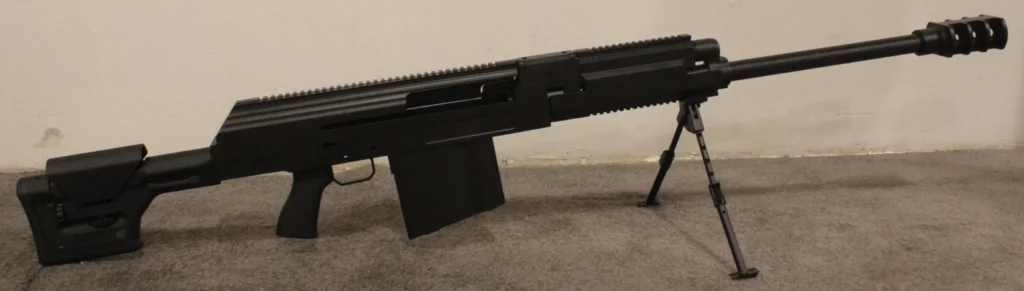
TheAK-50 is a project for a semi-automatic weapon chambered in .50 BMG, inspired by the legendary AK platform. Initiated by Brandon Herrera, an American gunsmith and content creator, this prototype aims to combine the simplicity and robustness of the AK-47 with the massive power of the .50 BMG caliber (12.7×99 mm NATO), usually reserved for anti-material rifles like the Barrett M82.
Although the AK-50 is not yet a mass-produced weapon, the project is widely followed by the gunmaking community and enthusiasts of innovative weapons. It illustrates a bold attempt to adapt a system historically designed for intermediate calibers to one of the world’s most powerful munitions.
Project conception and origins
The AK-50 project was launched around 2016 by Brandon Herrera. His initial idea: “What if you could shoot a .50 BMG bullet from an AK?”. This challenge, as technical as it was mechanical, required a complete overhaul of the original system.
Unlike a simple, enlarged AK, the AK-50 is designed as a long-recoil semi-automatic rifle, a system better suited to the power of the .50 BMG. The original mechanics of the AK are therefore profoundly modified, although the overall aesthetics of the rifle remain faithful to the iconography of the Kalashnikov :
AK handguard
Side safety lever
Removable metal charger
Solid barrel with imposing muzzle brake
Estimated technical data
| Element | Detail |
|---|---|
| Caliber | .50 BMG (12.7×99 mm) |
| System | Semi-automatic long recoil |
| Total length | ~1,500 mm |
| Barrel length | ~29 inches (~737 mm) |
| Estimated weight | ~12 – 15 kg |
| Magazine capacity | 5 shots (removable, metal) |
| Materials | Steel, aluminum, reinforced polymer |
Note: These features may change over time.
Technical challenges
Adapting a gun for the .50 BMG caliber represents an enormous challenge, both in terms of pressure and mass. Critical points include:
Massive recoil: requires ultra-efficient muzzle brake and reinforced construction
Feed cycle: requires a long recoil system rather than a conventional gas piston
Shooter safety: breech locking, throttle management and barrel strength must be beyond reproach.
Size: despite its imposing size, the design retains the AK spirit, while supporting extreme dimensions.
The project is progressing slowly but surely, with prototypes regularly tested and documented on YouTube.
Comparison with other .50 BMG rifles
| Model | System | Main application |
|---|---|---|
| AK-50 (prototype) | Semi-auto (long recoil) | Experimental, civilian |
| Barrett M82A1 | Semi-auto (gas) | Military, anti-material |
| Serbu BFG-50 | Lock | Civilian, long range |
The AK-50 stands out for its radically different approach, combining AK aesthetics with mechanical innovation. It is not intended to replace proven military systems, but rather to offer a unique and original weapon on the American civilian market.
Current status and future of the project
In 2025, the AK-50 remains in the development phase. Several videos show shooting tests, technical adjustments and design iterations. The designer is aiming for limited production, but no official market date has yet been announced.
The project enjoys a high profile on social networks, where it arouses enthusiasm, skepticism and a great deal of humor. The branding around the project is deliberately playful, with a nod to American gun excess.
Conclusion
TheAK-50 is much more than just an enthusiast’s joke: it’s an ambitious project, technically demanding and deeply rooted in contemporary gunmaking culture. An unlikely fusion of the Soviet AK icon and the most devastating caliber on the civilian market, it embodies a form of extreme creativity at the service of ballistic engineering.
Although it will probably never become a widely-used weapon, the AK-50’s audacity has left its mark on the minds of enthusiasts of extraordinary performance and design.