Introduction
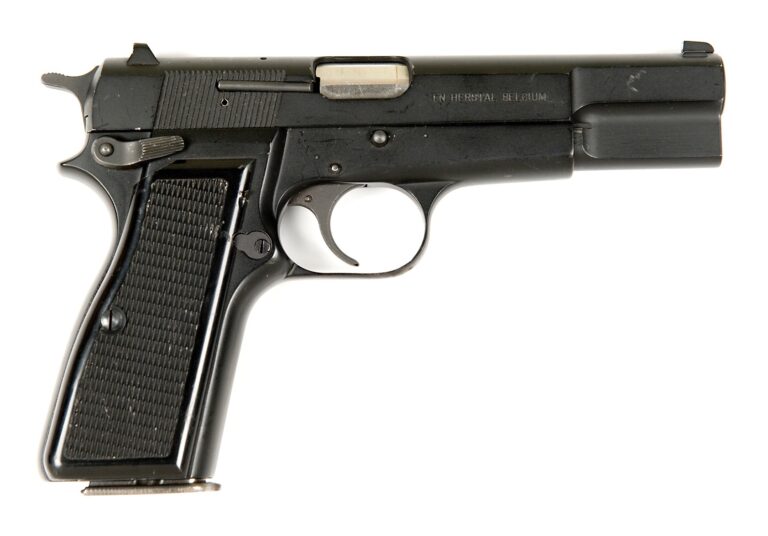
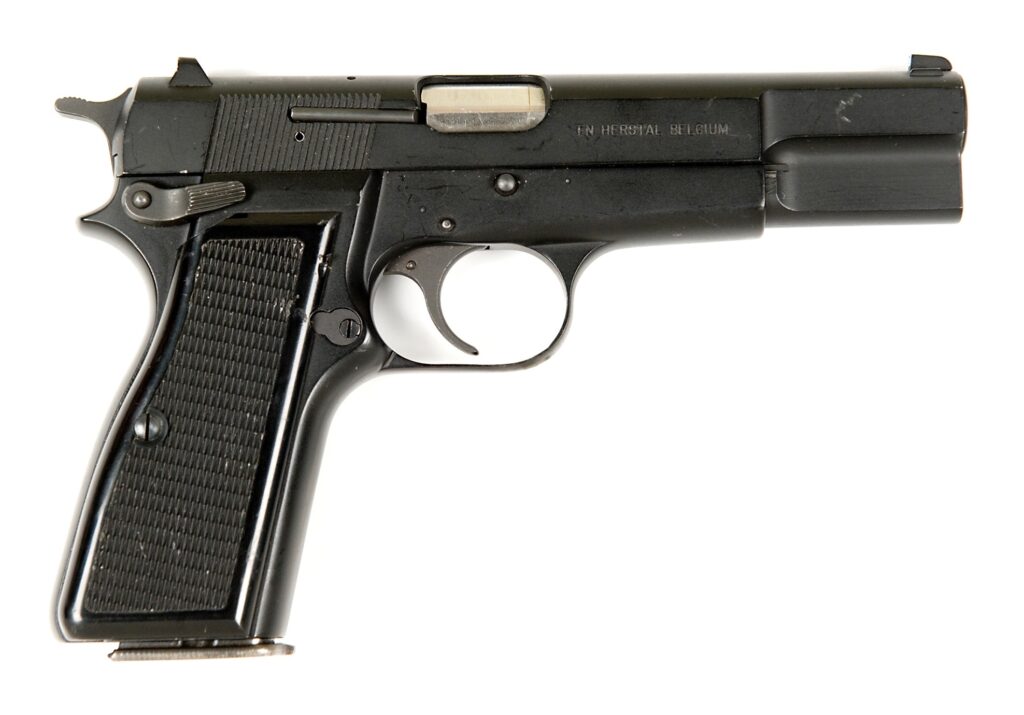
The Browning Hi Power is a metal-framed semi-automatic pistol, fed by a double-column magazine. Initially designed to meet military specifications, it is chambered mainly in 9×19 mm and was used as a service pistol in many countries throughout the 20th century.
History and development
The development of the Browning Hi Power begins between the wars. John M. Browning worked with Fabrique Nationale d’Herstal (FN) on a new pistol for the military market. After Browning’s death, the project was continued and finalized by FN engineer Dieudonné Saive.
The pistol was officially adopted in the mid-1930s. It was soon exported and found itself in service with various armies and security forces. During the Second World War, examples were produced in a variety of contexts, depending on facility control and user requirements.
After the conflict, the Browning Hi Power continued to be manufactured and modernized by FN. It remained in production for several decades, with various detail improvements, and enjoyed wide international distribution.
Design and operation
The Browning Hi Power is a semi-automatic pistol with short barrel recoil. Locking is by means of a tilting barrel, with a breech that recoils to extract and eject the fired case, then chamber a new cartridge.
The gun is fed by a double-column magazine, allowing a higher capacity than single-column magazine pistols of the same period. The magazine is inserted into the grip and released by a retaining button close to the trigger guard.
The Hi Power is a single-action pistol. The hammer must be cocked for the trigger to release the percussion mechanism. A manual safety is located on the side of the frame and locks the mechanism when engaged.
Sights generally comprise a fixed front sight and a notched rear sight, factory-set for a given type of ammunition. Some variants feature adjustable sights or different shapes for different production periods.
Technical specifications
| Characteristic | Guidance value |
|---|---|
| Main manufacturer | FN Herstal |
| Model | Browning Hi Power |
| Type | Semi-automatic pistol |
| Country of origin | Belgium |
| Standard calibres | 9×19 mm, .40 S&W on some versions |
| Operation | Short recoil, tilting barrel |
| Relaxation mode | Single action |
| Magazine capacity | Approx. 13 shots in 9×19 mm depending on magazine |
| Frame material | Steel |
| Overall length | Approx. 200 mm |
| Barrel length | Approx. 118 mm |
| Unloaded weight | Approx. 1 kg depending on version |
| Sights | Fixed front sight, notched rear sight |
| Loader type | Double column, removable |
Their main interest
The Browning Hi Power is designed to offer a high-capacity service pistol for its time, thanks to its 9×19 mm double-column magazine. Its design aims to combine high ammunition capacity with handle ergonomics suited to military and safety use.
The steel structure and short-recoil operating principle are in keeping with the pistols of the first half of the 20th century, while incorporating a larger-capacity magazine and an architecture geared to the needs of the armed forces.
Main variants
Over the course of its production, the Browning Hi Power underwent several variants and evolutions. Differences appear in finishes, sights, grip shapes and certain internal elements.
So-called “early” versions and later models are distinguished by the shape of the extractor, which is internal on some series and external on others. Surface treatments and grip inserts also vary according to period and contract.
Variants in .40 S&W are introduced later, with adaptations designed to handle this different caliber from the 9×19 mm. These versions retain the general architecture of the Hi Power, while incorporating the necessary modifications to the chamber and slide.
Comparison with other guns
Compared to contemporary pistols with single-column magazines, such as some .45 ACP models, the Browning Hi Power stands out for its increased 9×19 mm capacity, thanks to its double-column magazine. This feature is an important element of its design.
Compared with other service pistols of its time, it falls into the category of all-steel handguns, with an architecture suited to intensive use in military or security settings. Its increased capacity places it in a special position compared with lower-capacity models.
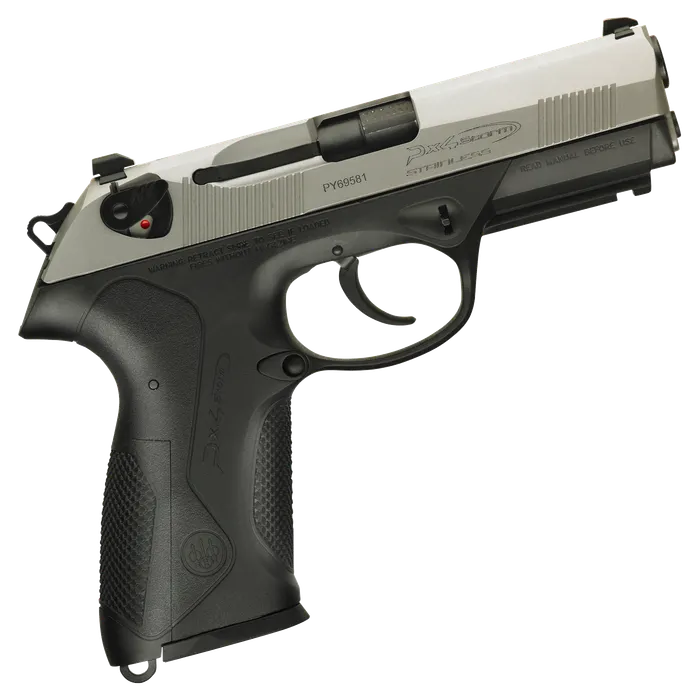
With the emergence of more recent high-capacity polymer-framed pistols, the Hi Power remains representative of a generation of all-steel pistols with double-column magazines, while being older in design than some modern platforms.
Conclusion
The Browning Hi Power is a semi-automatic pistol with a metal frame and double-column magazine, initially developed to meet military needs. Primarily chambered in 9×19 mm, it combines a classic short-recoil architecture with a magazine capacity large for its period of conception.
Its development with the participation of FN Herstal and the legacy of John M. Browning’s work make it a landmark model among twentieth-century service pistols. The various variants produced over the years demonstrate the model’s ability to adapt to user requirements and to changes in the calibers available.