Introduction
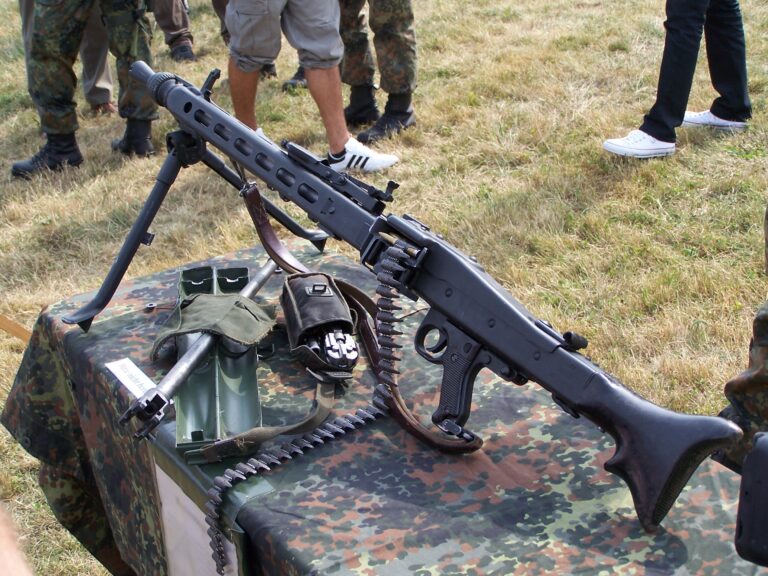
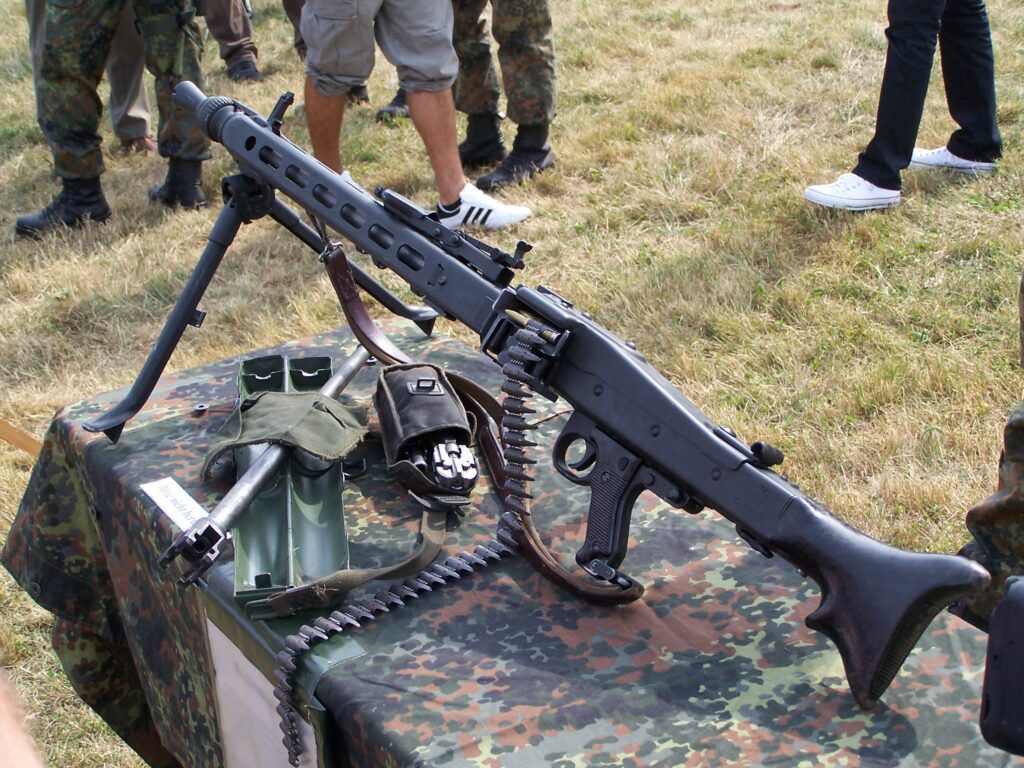
The MG3 is a German-designed multi-purpose machine gun (GPMG), chambered in 7.62×51 mm NATO. It is a direct descendant of the World War II MG42, from which it takes its general architecture, while being adapted to standard NATO ammunition and post-war requirements. It is designed for use on a bipod, tripod or vehicle mount.
History and development
After 1945, the new West German army was looking for a modern machine gun capable of fulfilling both the role of a collective support weapon and that of a defensive weapon on a gun carriage. The MG42 was considered a sound technical basis, but was chambered in 7.92×57 mm Mauser, a caliber not compatible with NATO standards.
In the 1950s, Rheinmetall reworked the MG42 to adapt it to the 7.62×51 mm NATO caliber. Several intermediate stages culminated in a stabilized version, officially designated MG3 in the early 1960s. The MG3 was adopted by the Bundeswehr and exported to many countries.
For several decades, the MG3 remained the German army’s standard machine gun. It was gradually replaced in this role by the MG5, but is still in service in some units and in many partner countries.
Design and operation
The MG3 is a recoil-operated machine gun with a roller-lock mechanism. The system is based on the mechanical principle of the MG42, with a roller breech that locks into the barrel when fired, then unlocks under the effect of recoil.
The weapon is fed by metal strips, generally 50-shot segmented non-disintegrating strips, which can be connected together to form longer lengths. Feeding is from the left-hand side, with a hinged top cover guiding the strip to the breech.
The MG3 has a theoretically high rate of fire, often between around 1000 and 1200 rounds per minute, depending on the breech weight used. This rate can be adjusted by choosing different breech and spring assemblies.
The barrel is interchangeable, and should be replaced regularly in sustained use to limit overheating. A protective sleeve and handle allow the barrel to be handled more safely during changes.
Technical specifications
| Features | MG3 |
|---|---|
| Country of origin | Germany |
| Main manufacturer | Rheinmetall and other subcontractors |
| Type | Multi-purpose machine gun (GPMG) |
| Calibre | 7.62×51 mm NATO |
| Operation | Reverse, locking by rollers |
| Firing mode | Automatic only |
| Power supply | 7.62 mm metal strip |
| Overall length | Approx. 1225 mm |
| Barrel length | Approx. 565 mm |
| Weight (without belt) | Approx. 10.5 to 11.5 kg depending on version |
| Theoretical firing rate | Approx. 1000 to 1200 shots/min |
| Sights | Adjustable rear sight, front sight |
| Mounting options | Tripod, tripod, vehicle mount |
How to use it
The MG3 is designed as a multi-purpose machine gun, capable of fulfilling the role of section support weapon on bipod and heavy support weapon on tripod. On a bipod, it accompanies infantry groups and provides direct supporting fire. On a tripod, it can be used for longer-range fire, with more accurate aiming devices.
The weapon can also be mounted on combat vehicles, armored vehicles or roof-mounted mountings for close defense and convoy protection. In this context, it is often fed by longer, pre-prepared belts.
Using the MG3 requires rigorous management of barrel warm-up, barrel change and belt preparation. Crews are generally organized in teams, with one gunner, one outfitter and, depending on doctrine, a third member responsible for transporting and preparing ammunition.
Main variants
Several MG3 variants are available, depending on contracts, licensed manufacturers and specific adaptations.
MG3 standard
Basic version, used on bipod, tripod or vehicle mount, with standard barrel and high cadence.
MG3A1 and related versions
Some variants incorporate detailed differences in muzzle brake, sights, stock or accessories, depending on the needs of the user forces or manufacturing developments.
Licensed production
The MG3 has been produced under license in a number of countries, sometimes with their own designations and specific details (finish, markings, national tripods, etc.). These variants generally retain the basic architecture and operation of the MG3.
Maintenance and accessories
The MG3 comes with a range of accessories for maintenance, transport and extended use.
Typical accessories include replacement barrels, breech and locking mechanism maintenance tools, oilers, cleaning kits and basic spare parts.
Special tripods enable sustained and indirect shooting at longer distances, with elevation and azimuth adjustment systems. Ammunition boxes and belt drums facilitate transport and feeding of cartridge belts.
Comparison with other machine guns
The MG3 is a direct descendant of the MG42, whose mechanical principle and all-purpose machine-gun concept it adopts. Compared with the MG42, the MG3 is chambered in 7.62×51 mm NATO instead of 7.92×57 mm, and incorporates adaptations to match post-war standards.
Compared with other modern 7.62×51 mm NATO multi-purpose machine guns, the MG3 stands out for its high theoretical rate of fire and its roller-locking system inherited from the MG42. Other models use gas-borrowing systems or more moderate rates of fire, depending on national doctrines.
Tripods, optics and accessories associated with the MG3 may differ from country to country and from production period to production period, resulting in a variety of configurations in the field.
Conclusion
The MG3 is a versatile machine gun inherited from the MG42, adapted to the 7.62×51 mm NATO caliber and widely used by Germany and many other countries. It combines proven architecture, belt feed and a high theoretical rate of fire.
Historically and technically, the MG3 occupies an important place among post-war machine guns, as a direct development of an earlier model and as the standard weapon of many armed forces. It illustrates the transition from the machine-gun concepts of the Second World War to the collective weapons standardized within NATO in the second half of the twentieth century.
The MG3 is a versatile machine gun inherited from the MG42, adapted to the 7.62×51 mm NATO caliber and widely used by Germany and many other countries. It combines proven architecture, belt feed and a high theoretical rate of fire.
Historically and technically, the MG3 occupies an important place among post-war machine guns, as a direct development of an earlier model and as the standard weapon of many armed forces. On the civilian market, particularly in Switzerland, its status depends on weapons legislation, its mode of operation and its legal status (functional, semi-automatic or neutralized).