Thompson | American gun icon
Introduction
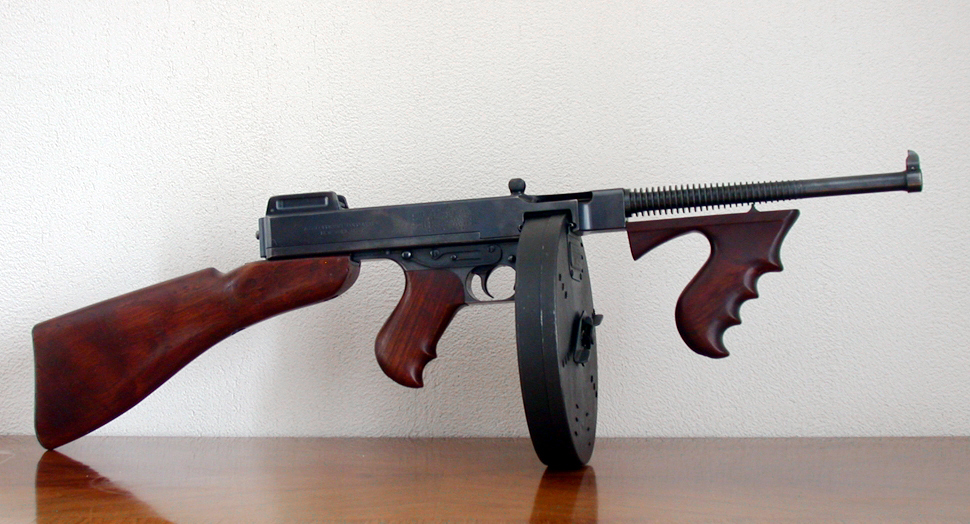
The Thompson, nicknamed the “Tommy Gun”, is one of the most iconic machine pistols of the XXᵉ century. Designed in the 1910s by General John T. Thompson, it first established itself as an innovative weapon of war, then became an unavoidable symbol of organized crime during Prohibition, before returning to its military vocation during the Second World War.
Its recognizable design, rapid rate of fire and drum magazine have made it a weapon of legend, as feared on the battlefield as it is mythologized in film noir and gangster stories.
Historical development and beginnings
The Thompson’s development began at the end of the First World War. John T. Thompson wanted to create a“trench sweeper“, capable of firing in bursts in close combat. The first model, the Thompson M1921, appeared in 1921, too late for the war, but soon became available on the civilian market.
The weapon’s robustness and high rate of fire attracted the attention not only of law enforcement agencies, but also of organized crime. American gangsterism in the 1920s and 1930s gave it massive exposure, notably through figures like Al Capone.
Technical specifications
| Element | Detail |
|---|---|
| Caliber | .45 ACP |
| System | Blowback with open cylinder head |
| Firing rate | ~600 to 800 shots/min |
| Length | Approx. 850 mm |
| Weight | 4.8 – 5.5 kg depending on model |
| Magazine | 20/30 shots (box) or 50/100 (drum) |
| Materials | Steel, wood |
Main models
The Thompson has gone through several versions, adapted to the needs of the armed forces or civilian markets:
M1921: First high-end commercial model with 100-shot drum magazine
M1928: Cutts compensator added, improved sighting, used by Marines
M1/M1A1: Simplified wartime version, mass-produced without drum magazine
M1927: Semi-automatic version for the US civilian market
Military use
The Thompson’s military popularity exploded during the Second World War. It was used by :
The US Army in all theaters of operation
British commandos and Canadian troops
French Resistance fighters and other Allied movements
Its effectiveness in close combat, especially in urban or forest environments, has made it a formidable weapon, despite its weight and bulk.
The Thompson M1A1 became the standard version for the US army, producing over 1.5 million units duringthe war.
A presence in popular culture
The Thompson remains a central figure in the collective imagination:
Cinema: used in gangster films(The Untouchables, The Godfather) and war films
Video games: featured in Call of Duty, Medal of Honor, Mafia
Comic books and novels: often associated with the 1930s, the underworld and private detectives
Its drum magazine and distinctive front handle give it a unique visual signature.
Comparison with other machine pistols of the period
| Model | Caliber | Firing rate |
|---|---|---|
| Thompson M1A1 | .45 ACP | ~600-700 cps/min |
| MP 40 | 9×19 mm | ~500-550 cps/min |
| PPSh-41 | 7.62×25 mm | ~900-1,000 cps/min |
The Thompson fires more slowly than the Soviet PPSh-41, but benefits from a heavier, harder-hitting caliber, ideal at close range. Compared with the German MP 40, it is more powerful but also heavier and more expensive to produce.
Heritage and collection
Today, the Thompson is a sought-after collector’s item:
Original versions highly prized on the historical weapons market
Semi-automatic reproductions still made in the USA
Used in historical re-enactments, museums and film shoots
Its aura remains intact among military history buffs and classic weapons enthusiasts.
Conclusion
The Thompson isn’t just a machine pistol: it’s a piece of history. From its beginnings as a tool of war to its notoriety among gangsters, it symbolizes America from the 1920s to 1945, at the crossroads of the military, criminal and popular worlds.
Its rugged design, .45 ACP power and singular aesthetic make it a legend of the XXᵉ century, still celebrated today as one of the most iconic machine pistols ever conceived.