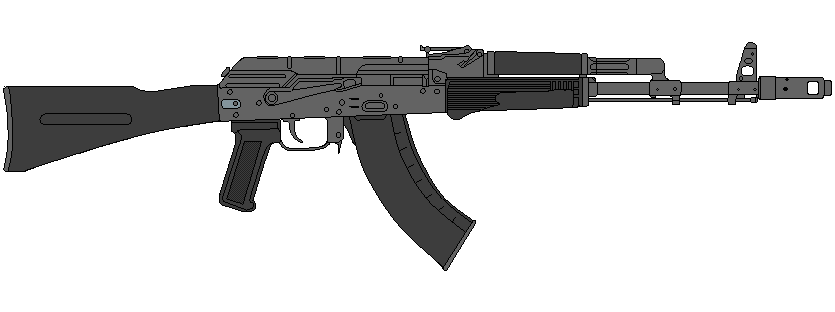
The AK-103 is a Russian 7.62×39 mm assault rifle, developed by the Izhmash firm (now Kalashnikov Concern) in the 1990s. Designed as a modernized version of the famous Kalashnikov platform intended primarily for export, the AK-103 combines the legendary reliability of the AK-47 with contemporary materials and ergonomics. Sometimes nicknamed “Black Kalashnikov” because of its all-black finish, it is now in service with many armed forces around the world.
History and Development of AK-103
In the early 1990s, after the collapse of the Soviet Union, the Russian military industry faced a major challenge: to modernize the Kalashnikov range while meeting the demand of the international market. The Red Army had considered replacing the AK family with the Nikonov AN-94, but its cost and complexity reserved it for elite units.
It was in this context that Izhmash, the State Plant No. 100 in Izhevsk, developed the AK-10x series. A new version of the AK-74, the AK-74M, was adopted in 1991 and became the standard rifle. The AK-10x series was directly derived from it, but declined in different calibers to meet the needs of foreign armies using NATO ammunition or the classic 7.62×39 mm.
The AK-103 specifically uses the 7.62×39 mm caliber, the most common in the world among the countries using the Kalashnikov platform. This strategic choice allows it to impose itself on nations that already have large stocks of this ammunition, without requiring costly logistical changes.
Technical Specifications
| Feature | Specification |
|---|---|
| Official designation | AK-103 |
| Country of Origin | Russia |
| Manufacturer | Izhmash / Kalashnikov Concern |
| Years of production | Since 1994 |
| Caliber | 7.62 × 39 mm M43 |
| Action | Gas borrowing, rotating cylinder head |
| Semi-automatic and automatic | firing modes |
| Total length | 943 mm (stock extended) / 700 mm (stock folded) |
| Barrel length | 415 mm |
| Weight (empty) | 3.5 kg |
| Magazine capacity | 30 rounds |
| Rate of fire | 600 rounds/min |
| Muzzle velocity | ≈ 715 m/s |
| Effective range | 400 m |
Operation and Technical Innovations
The AK-103 uses the proven gas-borrowed mechanism and long piston of the Kalashnikov family. The cylinder head is locked by rotation, a system known for its exceptional robustness in the face of dust, mud and extreme weather conditions.
Compared to older AK models, the AK-103 introduces several notable improvements. The stock is made of fiberglass-reinforced polymer and folds to the left side of the breech housing, providing increased compactness for in-vehicle or urban operations. Polymer trim replaces traditional wood, reducing weight while improving weather resistance.
A side mounting rail is integrated on the left side of the breech housing, allowing for the installation of riflescopes, red dots or night vision systems. The black phosphate finish provides better corrosion protection compared to the bluing of older models.
The muzzle compensator has also been redesigned to reduce barrel lift during automatic firing, a historical weakness of the 7.62×39mm caliber due to its steeper recoil than the 5.45×39mm.
Variants and Versions of the AK-10x Series
The AK-103 is part of a complete family of modernized assault rifles, each available in a different caliber:
The AK-101 is chambered in 5.56×45 mm NATO with a 415 mm gun, intended for countries using NATO standard ammunition. The AK-102 is the compact version with a barrel shortened to 314 mm. The AK-104 is the compact version of the AK-103, chambered in 7.62×39 mm but with a barrel of only 314 mm. The AK-105 uses the Russian caliber 5.45×39 mm in a compact version.
The AK-107 and AK-108, in 5.45 and 5.56 mm respectively, are distinguished by a dual-piston system with a balance weight, designed to compensate for the displacement of mass to the rear and drastically reduce the elevation of the barrel during automatic firing.
Users and Armed Forces
The AK-103 is enjoying significant commercial success in the military export market. Venezuela has signed a major contract for the licensed production of the AK-103, establishing an assembly plant on its territory. Saudi Arabia, Algeria, and India are also among the notable users.
Other countries that have adopted the AK-103 for their armed or security forces include Lebanon, Libya, Iran, Syria, Pakistan, Indonesia, Malaysia, Singapore, Thailand, Uruguay, Cyprus, and Somalia. This widespread adoption is a testament to the appeal of the 7.62×39mm in markets where it remains the logistics standard.
Civil Possession in Switzerland
In Switzerland, the AK-103 is classified as a semi-automatic weapon subject to a weapons acquisition permit under the Federal Weapons Act (Arms Act). The purchaser must be at least 18 years of age, not subject to general guardianship, and not present any grounds for refusal within the meaning of the law.
The civilian semi-automatic versions of the AK platform, such as those marketed by Izhmash under various names, are available from approved Swiss gunsmiths. It is important to note that only the semi-automatic versions are authorized for civilian sale; any weapon capable of automatic fire requires an exceptional cantonal authorization, which is rarely granted to individuals.
Conclusion
The AK-103 represents the culmination of the Kalashnikov philosophy applied to the demands of the modern military market. By retaining the 7.62×39 mm caliber acclaimed by dozens of nations while incorporating contemporary materials and ergonomics, it has established itself as one of the most exported assault rifles of the post-Soviet period. Its reliability inherited from the AK platform, combined with its siderail customization capabilities, makes it a pragmatic choice for militaries seeking a balance between proven performance and modernity.