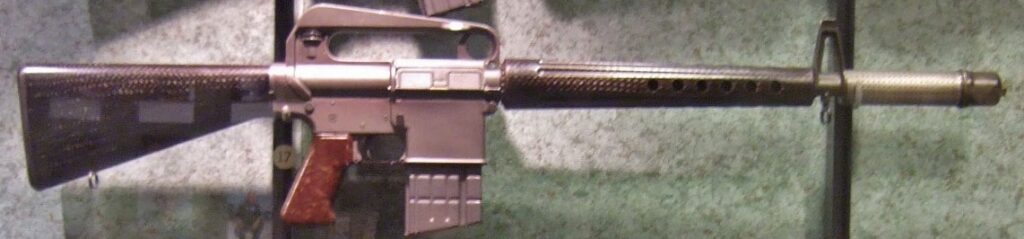
The AR-10, or ArmaLite-10, is an American 7.62 caliber NATO (.308 Winchester) combat rifle, designed by engineer Eugene M. Stoner for the ArmaLite firm in 1956. A pioneer in its materials and design, it was it that gave birth to two of the most iconic rifles of the twentieth century: the AR-15 and the M16. Although it was only produced in limited numbers, the AR-10 remains an essential historical reference in the evolution of modern small arms.
History and Development of the AR-10
In the early 1950s, the ArmaLite division, part of the Fairchild Engine & Airplane Corporation, sought to break into the U.S. military market with innovative small arms. In December 1955, Eugene M. Stoner presented the X-02 prototype at Fort Moore to representatives of the military. The demonstration was a success: the weapon lasted two days of intensive testing without any incident. The AR-10 then competed with the Springfield M14 for the U.S. Army’s light weapons program.
Despite its undeniable qualities — lightness, reliability and precision — the AR-10 lost to the M14, officially adopted by the U.S. Army in 1959. Production stopped in 1960, after about 10,000 units. The weapon was nevertheless exported and produced under license in the Netherlands, which allowed several countries to acquire it. Eugene M. Stoner would later use the principles of the AR-10 to design the AR-15, a rifle that, under the name M16, would become the standard weapon of the American forces for decades.
Technical Specifications
| Feature | Specification |
|---|---|
| Official designation | ArmaLite AR-10 |
| Country of Origin | United States |
| Manufacturer | ArmaLite / Colt’s Manufacturing Company |
| Designer | Eugene M. Stoner |
| Years of production | 1956 – 1960 (original production) |
| Caliber | 7.62×51 mm NATO (.308 Winchester) |
| Semi-automatic and automatic action, gas borrowing, rotating cylinder head | |
| Fire Modes | Semi-Automatic / Automatic (Fire Selector) |
| Total length | 1,030 mm |
| Gun length | 508 mm |
| Weight (empty) | 3.3 kg |
| Magazine capacity | 20 rounds |
| Rate of fire | 700 rounds/min (automatic) |
| Practical range | ~600 m |
| Copies produced | ~10,000 |
Operation and Technical Particularities
The AR-10 operated by gas borrowing with a moving assembly serving as an internal piston — a gas supply system known as “direct impingement” that would be used on the AR-15 and M16. The breech was a rotating multi-stud breech, inherited from the M1941 Johnson rifle, providing a solid lock to the chamber. This mechanism, combined with the pioneering use of aeronautical materials such as fiberglass, polymers and aluminum, made the AR-10 remarkably light for its time.
The weapon is equipped with a fire selector to switch from semi-automatic to automatic mode. The sight consists of an adjustable eyecup and a protected blade front sight, with a practical range of about 600 meters. Some versions can fire rifle grenades (with metal stock) and accept a scope. The stock, the carrying handle and the handguard directly foreshadow those of the M16, testifying to the continuity of design between the two weapons.
Variants and Versions
The original AR-10 was produced in several configurations depending on the market. The Dutch version, manufactured under license, accounts for the majority of exports to Portugal, Sudan and other countries. The SR-25 (Stoner Rifle 25) is a modernized version of the AR-10 developed by Eugene Stoner in collaboration with the Knight’s Armament Company (KAC) in the 1980s, a 7.62 caliber NATO sniper adopted by U.S. Special Forces. Since the original patent expired and the commercial relaunch by ArmaLite Inc. in 1996, many manufacturers—including DPMS, Palmetto State Armory, Aero Precision, and others—have produced their own versions of the AR-10 for the U.S. civilian market, often under the generic “308 AR” or “LR-308”.
Users and Armed Forces
Despite a limited production volume, the AR-10 was adopted by several armies. Portugal was the most notable user: the Portuguese armed forces used it intensively during the colonial wars (1961-1974) in Africa, where it distinguished itself by its accuracy and reliability in tropical conditions. These weapons came from the Netherlands via a Brussels trading company. After the colonial wars, some of these Lusitanian examples were found in the Angolan (1975-2002) and Mozambican civil conflicts. The AR-10 was also adopted by Burma, Italy, Sudan and the National Guard of Guatemala.
Heritage and Civil Renaissance
The main legacy of the AR-10 lies in the platform it spawned: the AR-15 and M16, developed by Stoner directly from his design principles, would become the most produced military rifles in the world. The AR-10 itself experienced a renaissance starting in 1996, when ArmaLite Inc. put it back into production. The expiration of the original patent allowed many manufacturers to offer their own versions, creating a thriving civilian market in the United States. In popular culture, the AR-10 appeared in the film “The Professional” (1981), where Jean-Paul Belmondo used it equipped with a Colt scope, as well as in several other film productions.
Civil Possession in Switzerland
In Switzerland, the semi-automatic versions of the AR-10 are available for purchase from specialist gunsmiths. The civilian models are configured to operate only in semi-automatic mode. In accordance with the Federal Weapons Act (Arms Act), the acquisition requires a weapons acquisition permit issued by the competent cantonal authority. The conditions include: being at least 18 years old, not under general guardianship, and not presenting a reason for refusal within the meaning of Art. 8 para. 2 Arms Act. The original automatic versions are specially authorised weapons, subject to much stricter regulations. As the .308 Winchester calibre (7.62×51 mm NATO) is widely used in Switzerland for long-range sport shooting, the AR-10 semi-auto is a popular option for Swiss sport shooters.
Conclusion
The AR-10 is more than just another weapon: it is the birthplace of one of the most influential rifle families in modern history. Designed by a visionary, made with cutting-edge materials, it laid the groundwork for a revolution in small arms design. While its direct military journey was brief, its legacy — the AR-15, M16, SR-25 and thousands of civilian variants — is pervasive in contemporary weaponry.