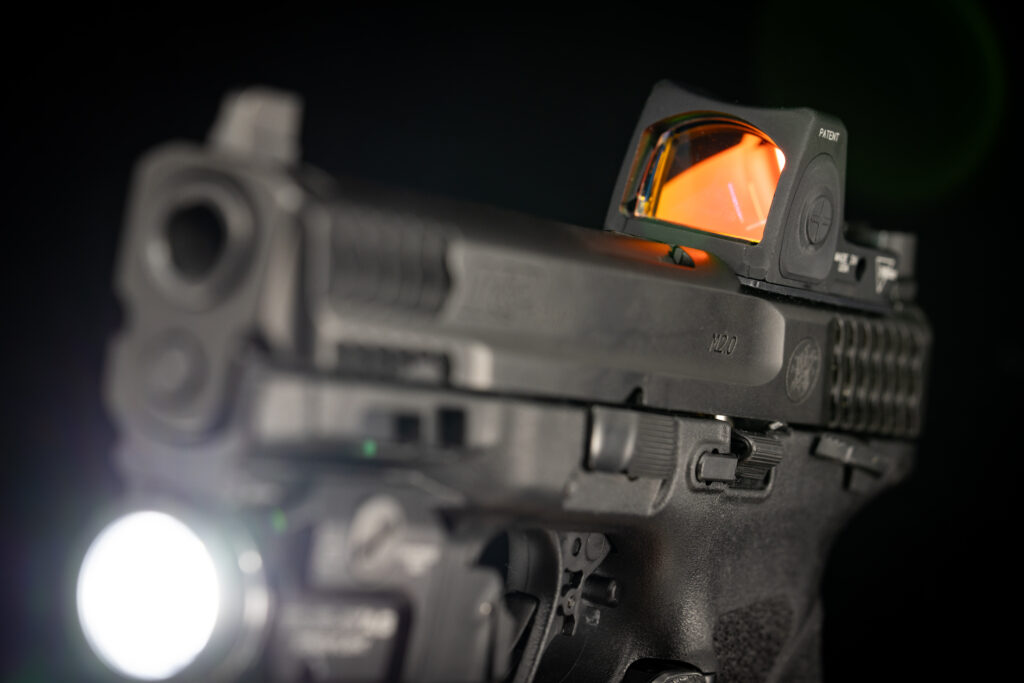
The Trijicon RMR Type 2 (Ruggedized Miniature Reflex) is an American miniature reflex sight designed and manufactured by Trijicon, Inc. since 2017. An improved successor to the original RMR, it has established itself as the global benchmark for compact sights for pistols and rifles, especially after its adoption by the United States Special Operations Command (USSOCOM) in 2018. Its exceptional ruggedness, reliability under the most extreme conditions, and patented impact-resistant housing make it the go-to choice for military operators and demanding civilian shooters.
History and Development of the Trijicon RMR Type 2
Trijicon, founded in 1981 in Wixom, Michigan, is known for its innovative sighting systems that incorporate autonomous light sources. The original RMR was introduced in the 2000s to meet a growing demand for compact sights that could be mounted directly on pistol slides. Faced with feedback from U.S. Special Forces reporting electronic reliability problems on the Type 1 during heavy pistol use—especially under the extreme vibrations generated by the breech cycle—Trijicon undertook a complete overhaul of the electronics and housing.
The RMR Type 2 was unveiled in 2017 with a completely redesigned electronic architecture, reinforced battery contacts, and a patented housing geometry that derives mechanical stresses away from the lens. In August 2018, the Naval Surface Warfare Center Crane (NSWC Crane) selected the RMR Type 2 as part of USSOCOM’s Miniature Aiming System – Day Optics program, for a five-year, $7.6 million contract. This institutional adoption established the RMR Type 2 as the reference reflex sight for U.S. Special Forces, including Navy SEALs, Delta Force, and Rangers.
Technical Specifications
| Feature | Specification |
|---|---|
| Official designation | Trijicon RMR Type 2 (RM06 – 3.25 MOA version) |
| Country of Origin | United States |
| Manufacturer | Trijicon, Inc. (Wixom, Michigan) |
| Year of introduction | 2017 |
| Type | Open Reflex Sight |
| 1× magnification | (without magnification) |
| Main Reticle | 3.25 MOA (or 1 / 3.25 / 6.5 MOA depending on model) |
| Click Adjustment | 1 MOA per Click (Winding and Elevation) |
| Length | 45.7 mm (1.8 inches) |
| Width | 27.9 mm (1.1 inch) |
| Height | 25.4 mm (1.0 inch) |
| Weight | 34 g (1.2 oz) |
| Power source: | 1 CR2032 battery (lithium) |
| Battery life | 4+ years in continuous use (4/8 setting at 21°C) |
| Brightness Levels | : 8 Manual Settings + Auto Mode |
| mounting footprint | (Type 1 and Type 2 compatible) |
Operation and Technical Particularities
The RMR Type 2 works on the principle of the reflex sight : an LED projects a point of light on an angled semi-reflective lens, reflecting the image of the reticle back to the shooter’s eye without obscuring the field of view. The absence of magnification and the freedom of position of the eye allow you to aim quickly with both eyes open, ideal for dynamic shooting at close and medium distances.
The great innovation of the Type 2 lies in its patented geometry housing : its asymmetrical shape absorbs and deflects mechanical shocks away from the lens, solving the microcracking problems that plagued the Type 1. The reinforced battery contacts maintain electrical conductivity even under the intense vibrations of the cycle of a gun slide. The system offers 8 manual brightness settings as well as an adaptive automatic mode (on some versions) that adjusts the intensity according to the ambient light. The crossover adjustments are audible and tactile (discreet clicks), allowing precise adjustment without specific tooling. The mounting footprint is identical to the Type 1, ensuring backward compatibility with all existing holsters and mounts designed for the RMR.
Variants and Versions
The RMR Type 2 range is available according to the size of the reticle and the type of illumination. The RM06 model (3.25 MOA red adjustable LED) is the most common version, adopted by USSOCOM. The RM07 offers a 6.5 MOA reticle for faster acquisition in dynamic environments. The RM08 offers 1 MOA for maximum accuracy at longer distances. The RM04 is a dual illumination version (LED + tritium), requiring no battery but without manual brightness adjustment. The RMR Type 2 HRS (High-Speed Reflex Sight), introduced in 2023, features a slightly redesigned housing with a 30% wider optical window for even faster target acquisition, while retaining the standard RMR footprint. All versions are available in black or FDE (Flat Dark Earth) finish.
Users and Armed Forces
Since the 2018 selection, USSOCOM has equipped its elite units with the Type 2 RMR, including Navy SEALs, the 75th Ranger Regiment and Delta Force units on their service pistols (Glock 19 MOS, SIG Sauer P320). Many US federal agencies (FBI, DEA, US Marshals) have also adopted the RMR Type 2 for their tactical teams. In the civilian market, it has become the benchmark for USPSA/IPSC Open shooting, defensive fire and “Carry Optic” configurations. Police and military forces from several allied countries (Australia, United Kingdom, Canada, Israel) also use it individually or institutionally.
Civil Possession in Switzerland
In Switzerland, the Trijicon RMR Type 2 is an optical accessory for firearms, freely available for purchase without a specific permit for the accessory itself. It is offered by specialist gunsmiths and some online retailers. Its acquisition and mounting on a legally owned weapon does not require any additional administrative steps. The basic weapon on which it is mounted remains subject to the usual provisions of the Federal Weapons Act (Arms Act): cantonal acquisition permit for semi-automatic pistols, compliance with the age (18 years) and personal fitness requirements. The possession of a Type 2 RMR alone, without a weapon, is completely free in Switzerland.
Conclusion
The Trijicon RMR Type 2 represents the culmination of decades of experience in combat sights. By solving the reliability challenges of its predecessor while maintaining its universal footprint, it has established itself as the industry standard for pistol-mounted reflex sights. Its adoption by USSOCOM in 2018 and its dominant presence on competitive shooting ranges around the world is a testament to a design that has met the most stringent requirements, both military and civilian.